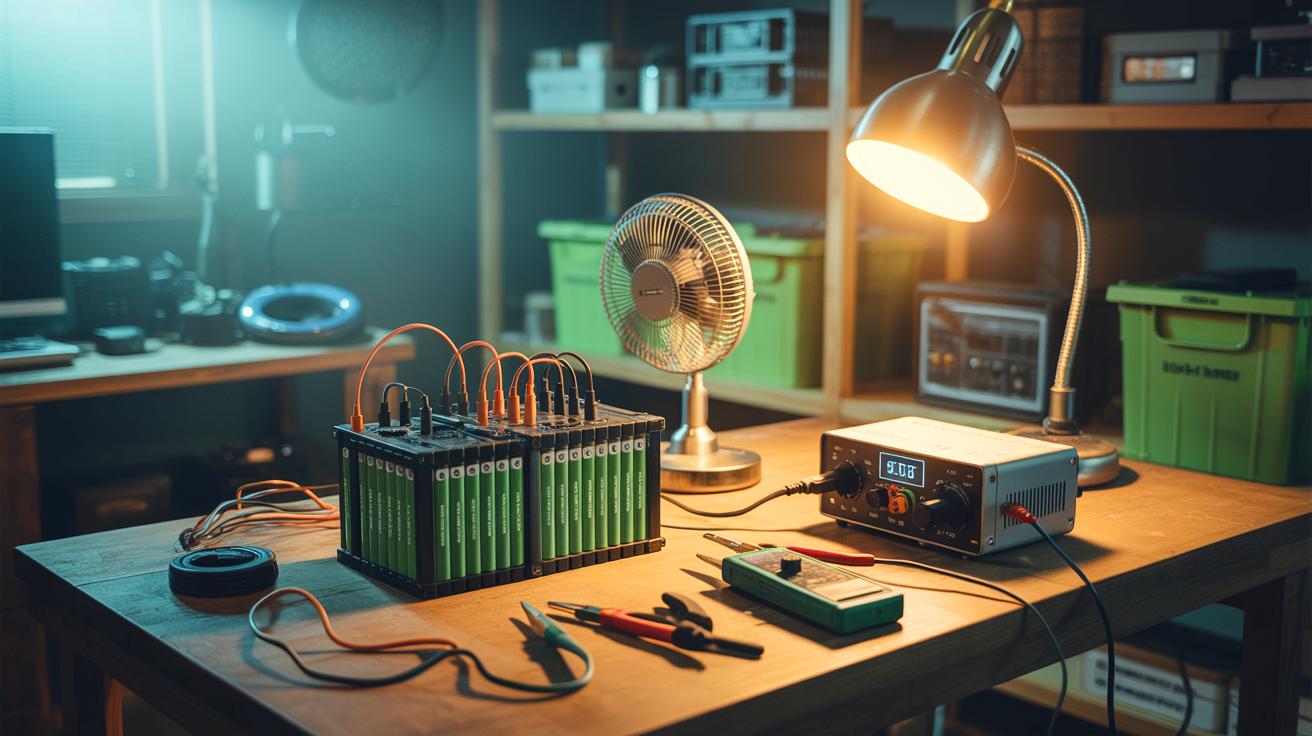
In a nutshell
- 🔋 From “junk” to power: reclaimed 18650 lithium‑ion cells paired with an inverter ran small appliances like fans, LED lights, and routers.
- 🧪 Practical method: test and match cell capacity (e.g., 3S layouts), add a BMS, fuses, and a ventilated enclosure; right‑size loads to maximize runtime.
- 📊 Hidden power: 12–24 V packs deliver roughly 100–300 Wh; sources like laptop/e‑bike packs, UPS units, alternators, and solar garden panels can support targeted devices.
- ⚠️ Safety and rules: avoid mixing chemistries, supervise charging, use pure sine wave inverters for sensitive electronics, and follow local e‑waste and labeling requirements.
- 🌱 Bigger picture: boosts household resilience, cuts e‑waste, and strengthens community through repair cafés and hands‑on learning.
It started as a curbside mystery: a scuffed plastic bin, rattling with odd green cylinders and frayed wire. Neighbors shrugged. Junk, they said, the end of something electronic and unloved. Then a volunteer at a community repair event opened the lid and paused. Those weren’t random parts. They were 18650 lithium-ion cells—the same rechargeable batteries that quietly power laptops, scooters, and tools. Tested, paired, and protected, they became the beating heart of a compact energy kit. Minutes later, a small inverter hummed to life, spinning a desk fan and lighting a work lamp. What everyone thought was trash turned out to be a portable power supply for small appliances, hiding in plain sight.
From Scrap to Supply: The Unexpected Battery Find
At a Midwestern repair café, a box of “dead” e-bike and laptop packs sat destined for recycling. A volunteer sorted the cells by brand and date codes, then pulled out a multimeter. Some read near zero. Others, surprisingly, showed healthy voltage. Over several hours with a simple capacity tester, the team matched cells of similar health, built a 12-volt pack using a 3S configuration (three cells in series) with several cells in parallel for more capacity, and added a BMS for balancing and protection. A fused lead connected to a 150-watt pure sine wave inverter. Flip the switch, and a sewing machine purred. The room fell silent, then erupted.
Used correctly, reclaimed cells can supply clean, reliable power for lights, routers, fans, and chargers. None of this was high-end lab work. It was careful, methodical tinkering—voltage checks, cell matching, clean solder or spot welds, proper heat-shrink, and strain relief. The takeaway is not that any battery is safe to reuse; it’s that tested cells, governed by a solid protection circuit and sensible loads, can transform “junk” into a practical home backup or off-grid companion. For the price of a used inverter and a handful of connectors, an entire workbench flickered back to life.
How Much Power Is Hiding In ‘Junk’?
The math is shockingly simple. A single healthy 18650 cell averages about 3.6–3.7 volts and 2,000–3,000 mAh, roughly 7–11 watt-hours. Group a dozen in a 3S4P layout and you’ve built an energy bank of about 100–130 Wh. Accounting for inverter losses, that’s an evening of LED illumination, or a Wi‑Fi router through a storm, or a gentle breeze from a 40-watt box fan for a couple of hours. Scale to 24 volts and capacity grows. Add solar, and you’ve made it renewable. A little power goes a long way when the targets are efficient and clearly defined.
| “Junk” Source | Hidden Power | Typical Output | What It Can Run |
|---|---|---|---|
| Old Laptop/E‑Bike Packs (18650) | Rebuilt Li‑ion battery bank + BMS | 12–24 V DC, 100–300 Wh | LED lamps, routers, small fans, phone/laptop chargers |
| Retired UPS Unit | Inverter + lead‑acid battery | 300–800 W (short duration) | Modems, CPAP (with care), lights, low‑power tools |
| Car Alternator | DC generation via bike/wind rig | 50–500 W (with regulator) | Charging a 12 V battery, then small AC loads |
| Solar Garden Panels | Trickle solar charging | 5–12 V, low current | Sensors, power banks, LED task lights |
The secret isn’t brute force; it’s right-sizing loads to match modest, reliable supply. A compact battery plus an efficient inverter can make a blackout survivable, keep a home office online, or power a craft fair booth without a noisy generator. The gold is in watts you don’t waste.
Safety, Legality, and the Right Way to Reuse
Reclaimed energy is only a win if it’s safe. Test every cell, retire the weak, and never mix different chemistries or wildly mismatched capacities. Use a reputable BMS sized for your pack’s current, add proper fuses, and choose pure sine wave inverters for sensitive electronics. Enclose cells in a ventilated, nonconductive case with strain relief on cables. Keep packs away from heat sources and flammables, and store at partial charge in a cool, dry place. Charging is the riskiest phase: use matched chargers, observe, and never leave packs unattended.
There are rules, too. Local e‑waste regulations govern how batteries are handled and transported; check your municipality. Don’t backfeed house wiring or improvise “grid-tie” hacks. Keep DIY systems isolated and portable. Label voltage, polarity, and maximum wattage. Remember that devices like medical equipment demand certified power. When in doubt, step back, downsize the load, and prioritize safety over convenience. If you lack tools like a spot welder, many community makerspaces have them alongside fire-safe storage and mentors who’ve done this before. Responsibility is part of the craft.
Why This Matters: Resilience, Cost, and Community
Across the U.S., households juggle high energy prices, heat waves, and grid hiccups. Small, silent, portable power keeps daily life moving—charging phones, powering a router for telework, or running a small fan when heat and humidity spike. Resilience lives in these practical details. Reusing components also cuts into the millions of tons of e‑waste Americans generate each year, redirecting useful cells, inverters, and panels from the scrap stream into service. It’s not a cure-all. But it’s a meaningful shift from disposability to design sense.
Then there’s the social spark. A repair café becomes more than a drop-off; it becomes a classroom. People learn what a watt is, why efficiency beats excess, and how a modest system can be smarter than a big, wasteful one. They leave with working lamps, a backup router plan, and a story about turning “junk” into a tool. That story travels, inspiring others to look again at what they were about to throw away. The culture changes one salvaged pack at a time.
In the end, the most surprising part of this discovery isn’t technical—it’s psychological. Once you’ve seen a pile of discarded cells light a room and run a fan, you stop treating old electronics as trash and start treating them as potential. You look for capacity, not clutter. You measure, match, and rebuild. And you realize resilience can be assembled on a tabletop. So the next time you spot “junk” on the curb, will you walk past—or will you wonder what small appliance it might power tomorrow?
Did you like it?4.5/5 (30)
Mind blown—those “junk” 18650s running a sewing machine is peak repair-café magic. Thanks for breaking down BMS, fuses, and pure sine in plain language; it makes the whole setup feel doable for weekend tinkerers. Saving e‑waste and keeping fans spinning? Chef’s kiss.
For a 3S4P pack around 120 Wh, how long would you expect a typical Wi‑Fi router plus modem to run, assuming 10–15 watts continuous? Any tips for minimizing inverter losses—DC buck converters instead, maybe?
So my junk drawer is secretly a micro‑grid? Next I’ll be charging the toaster with old scooter cells—kidding (mostly). Loved the reminder to label polarity; my future eyebrows thank you :).
Thx for the clear safety section. I’ve seen too many folks mix chemistries; your “test every cell, retire the weak” mantra is gold, and keeps our makerspace calmer.
Do you prefer spot‑welding nickel strip or using cell holders with bus bars? I’m decent at soldering but worry about heat soak on 18650s. Also, any favorite low‑cost BMS brands that don’t flake out on balancing?
We rebuilt an e‑bike pack last winter and kept our router alive during an ice storm. Right‑sizing loads was the lesson—LED lamps over floor heaters, obviously. Your table nails the expectations vs reality piece.
This reads like a heist movie: assemble the team, test the cells, flip the inverter, cue the fan whoosh. Only the loot is 130 Wh and a cool breeze. A+ storytelling.
Question—what gauge wire and fuse rating would you recomend for a 3S, 150W inverter setup? I don’t want to under‑size and create heat, or over‑fuse and miss protection. Newbie brain is frazzled, sry.
Love the community angle—repair cafés turning curiosity into capacity. I’m bringing my “dead” laptop pack next weekend and some donuts for the crew 😀
Appreciate the reminder about storing packs at partial charge. I had been topping to 100% and wondering why capacity faded fast. Learned my lesson, and my cells will thank me later.
Could a small CPAP run off a 24 V build with a quality pure‑sine inverter, or is DC‑DC a better route? Looking to plan responsibly for travel and outages.
This is wild—never thought garden solar panels could trickle into a pack and keep sensors alive overnight. My backyard is about to get way more nerdy, lol. Definately trying this weekend.
Any tips for labeling? Voltage, polarity, max wattage, and capacity seem obvious, but I’m thinking QR codes linking to test data and cycles. Overkill or actually helpful for lending packs?
Your “measure, match, and rebuild” line hit home. My grandpa fixed radios; now I’m fixing energy. Turning clutter into capability feels like the most hopeful DIY I’ve read all year.
Quick clarify: for routers and LED lights, would you bypass the inverter and run DC seperately when possible? Seems like fewer losses, longer runtime, and less noise—am I thinking right?